Sunday, November 18, 2012

What the 2012 Presidential Election Taught Us and What Conservatives Must Do About It.

We do live in two Americas, but not the two John Edwards imagined. In order not to waste your time, I’m going to dispense with any political correctness here. The future of our nation and the America our children and grandchildren will inherit is too important. We live in a country pretty clearly divided (generally speaking) by the “city-dwelling/single/childless/tax-supporting/secular/” versus the “suburban/rural/personally-responsible/married/family/religious.” None of this should be news to conservatives. These cohort trends have been clear for decades. What is news is that the former group members are showing up at the polls in large numbers and the latter are not.

We conservatives, particular the fiscally concerned, assumed the current economic status of our union would ensure a Romney win. Many of us couldn’t even comprehend the race would be close. Unemployment has been at around 8% or more for four years. Our national debt has doubled to more than $16 billion. 47 million Americans are on food stamps. Our economy is growing slower than it has since WWII. The President and Congress haven’t approved a budget in four years. The nation needed a proven leader who could fix the dire economic conditions, create new jobs, spur growth, reduce debt and improve efficiency in our federal government. We nominated one of the country’s most successful “turnaround” guys. Those of us over the age of 40 were convinced that this election was “about the economy, stupid.” On November 6th at around 10:00 pm, a lot of us, including many political experts and consultants, began to face the “new reality” of national elections in the United States.

There are more secular voters in America today who put “progressive” social issues above economic or religious values. Those issues include immigration, gay rights, global warming, free health care, college tuition assistance, abortion and the like. These voters clearly saw Romney as someone to fear because he would not give them the things they wanted. Like a child who doesn’t want Daddy to come home so the rules don’t have to be enforced, the Obama voters were motivated to keep Romney out of 1600 Pennsylvania Avenue. In my view, progressive voters are a lot like children – not wanting to, or perhaps not knowing how to, make hard decisions today about discipline for the benefit of tomorrow.

But we conservatives lost this election for other reasons, too. Barrack Obama showed us that relentless campaigning, astute social media marketing, pop culture public relations and sophisticated community organizing are all critical parts of winning elections today. The Obama campaign was simply superior in this regard. The administration has proven to be very poor at effective governing but it is truly impressive at executing political campaigns.


Obama and the liberals/progressives have successfully taken us to that tipping point whereby enough voters are hooked on the road to serfdom – exchanging their votes for goodies today that only weaken our tomorrow. The only way to beat this system is to nominate a candidate who can harness pop culture, be relevant to the youth, engage sports and media personalities, leverage social/digital media technology and who can be attractive to the young, old, urban and rural. Make no mistake; I am not suggesting a move away from conservatism in the least. What I am saying is that Ronald Reagan and Barack Obama have proven that the messenger is a critical part of the message. We have the right message. What we don’t have today is the messenger or the marketing. I don’t know who the next “voice” of the conservative movement is going to be. What I do know is that we better find an inspirational one. And, we better surround him/her with the modern marketing and communications tools necessary to win a national election in America in 2016. If we don’t, the conservative movement may end up just like vinyl musical albums – nice to listen to for nostalgia but not a lot of other citizens with the turntables required to hear the music.

The Pritchett Perspective: Preview "What the 2012 Presidential Election Taught Us and What Conservatives Must Do About It."

The Pritchett Perspective: Preview "What the 2012 Presidential Election Taught Us and What Conservatives Must Do About It."

Tuesday, November 9, 2010

PATHWAY TO PROSPERITY


Ten policy issues we must pursue if we value liberty

1) Embrace, enable and defend the free enterprise system. Provide businesses with a fair and predictable regulatory environment to encourage risk-taking and competition.
2) Establish a simple tax system with a flat rate that only taxes income one time. Watch as entrepreneurs put capital to work and our federal treasury revenues grow.
3) Reduce spending at all levels of government. Address the structural issues in our entitlement programs, which are draining more and more of our government budgets. Shrink the number of employees at all levels of government. Remember, governments don’t produce; they consume.
4) Ensure our defense of liberty by making our military strong. Make our foreign policy clear and unmistakable to our enemies.
5) Recognize that America must lead in the world so that liberty, security and prosperity are secured at home.
6) Enforce the existing immigration laws. We are all from somewhere else but we are united by our common, shared ideals and language. A bedrock principle of our system is the rule of law.
7) Empower parents to makes choices for their children’s education. Encourage competition and accountability in the public education system. Return the power to the states and the local communities for education.
8) Listen to the people. America remains a republic of “We The People.” We reject a centralized, top-down approach in Washington…no matter what party is in power.
9) Pass “Term Limit” legislation. Our representative republic was not designed with the intention of creating career politicians. Elected officials should be “reluctant servants” who return to their personal careers after a robust but short term of service.
10) Encourage and respect the vital role that family and religion play in our society. These civil institutions can provide better “welfare” for individuals more efficiently than government can – or ever has.

Tuesday, October 12, 2010

PUBLIC EDUCATION, FEDERALISM & THE FREE MARKET


Protecting Our Prosperity by Embracing Competition

Our Founding Fathers believed in a civic education for our children, preparing them for the requirements of self-government. The founders thought this public education was fundamental to the future prosperity of America. They were right. Jefferson wrote that his aim for a public education system was to ensure that all children could become “worthy and able to guard the sacred deposit of the rights and liberties of their fellow citizens.” In advocating for a civic education, Noah Webster wrote that its purpose was to “promote unity and create a sense of national spirit.” Madison, perhaps most succinctly espousing the crucial purpose of public education, wrote “the diffusion of knowledge is the only guardian of true liberty.” How disappointed these men would be to see how poorly and unfaithfully we have performed our duty to safeguard liberty in the area of public education. Over the past 40 years, we’ve simply failed.

If the education of a society is determined by how well it transmits true and time-honored values from generation to generation as the former US Secretary of Education, William J. Bennett has suggested, we have some serious character flaws to address. A lot of public school testing data has shown us just how little students know about our collective past. Without an understanding of the unifying ideals of freedom and equality that unite us as Americans, how can the next generation comprehend our nation’s greatness? We, as Americans, are at our greatest when we celebrate our common (shared) principles. Peoples from all over the globe have been attracted to America because they saw a country bound together not by a common ethnicity, but by loyalty to a principle. Our founding fathers understood that the education of our children is one of our civilization’s most critical tasks. We are failing and liberty is in jeopardy as a result. We must not allow a failing system to remain insitu. We must reclaim the public institution of education. It is our civic obligation. What’s more, from a purely pragmatic perspective, successful public schools are an economic necessity. Any growing and prospering community, whether local, regional or national, requires excellent public schools.

The current K-12 system is not an American one. It has become an autocratic, anti-competitive bureaucracy of the highest order. In a country founded uniquely upon the simple yet powerful ideal of “We the People,” we must return the power of education back to the people. The current business model must change. It is the only way we can remain competitive in the world. Every liberal, every public education lobbyist, every education union leader and incumbent education apologist will claim our problem is simply a matter of funding. This is not only a ridiculous and fatigued hypothesis; it is patently false based on decades of empirical data. The scientific evidence is overwhelming. There is no correlation between spending and educational achievement. In fact, the US spends more on education than any other nation in the world. Since 1960, federal spending on education has more than tripled while our aptitude has remained constant (using standard test scores).

Perhaps our biggest failure has been allowing the public education system to become a de facto function of the federal government. Since when does education power rest with the feds? The US Constitution does not authorize the federal government to control, manage or finance education. It wasn’t until the Carter Administration that we even had a Department of Education. The current White House Administration is encouraging (actually bribing) states to adopt a national education standard. In my view, nothing could be more counter productive than states, counties, communities, teachers and parents ceding their control and responsibilities to a centralized, bureaucratic, “standardized” department in Washington, DC. By the way, what happened to federalism? How did the constitution get completely ignored while the feds usurped the states’ rights to establish standards, tests and curriculum? There has been no public debate. There has been no vote in Congress. Not only is the process an assault on our founding principle of federalism, it is destined to fail because it ignores the customer in the equation. In a free market system, the schools would answer to the parents for the quality of the product. In the present scenario, the states have to answer to the federal government - devoting time and resources to fill out federal grant applications versus providing a better education to our children.

When public education works well, and it does in many places in our country, there are some important common denominators. The best and most productive schools are a result of local people, local leadership, community commitment and parental values. These “high performance” schools are not a result of federal tutelage. What makes an effective school? According to Ron Edmonds, formerly the Director of Urban Studies at Harvard, there are seven attributes:

1) Clear School Mission
2) High Expectation for Success
3) Instructional Leadership
4) Frequent Monitoring of Student Progress
5) Student Time On-Task
6) Safe and Orderly Environment
7) Home – School Relations

So, if we really want our public schools to work well, what should we do? The answer is simple. Take a look at what works in our business economy. Centralized, top-down, multi-layered management is not the answer. High performance companies move fast, are responsive to their customers and continually improve efficiency. Successful businesses empower their employees to solve customer problems at the local level because they understand that customers are the reason the company exists. If we want to dramatically improve our public education system, we must being the forces of competition to work in the education industry. Schools and school districts need to assure local control, empower parents, invite new and different people into school management and let good old fashioned competition drive out the weak, poorly performing and/or failing schools. We need to let all schools compete for tax-payer dollars. We need to de-construct the government-run monopoly. In a free market system, those who produce goods and services are ultimately answerable to the consumer. So it must be in our education system. No one cares more about the future of a child than his/her parent. We must give parents the power to choose and teachers the power to teach.

The Bill of Rights, specifically in the Tenth Amendment, limits the powers of the federal government by ensuring that states retain all powers not specifically delegated to the feds. This protects our liberties. It ensures the most vital and personal issues remain close to home. As citizens of the republic, we have an obligation to restrict federal power and to preserve a system of “We the People.” If we want to reverse the steady slide in our public education of the past 40 years, we need to heed the words of Madison, Jefferson and Webster. We need to take responsibility for the character of our society and for our competiveness in the world. We must adopt a system of accountability to measure the results of students, teachers and principals. Parents must be given the choice to send their children to schools they know will provide the best value. Our future prosperity and our liberty are at stake…and they are inextricably linked.

Wednesday, July 7, 2010

TOP TEN THINGS ABOUT BEING A SOUTHERN GENTLEMAN


Of all the things I’ve written about, this one is likely to generate the most discussion and disagreement. So, here are my ten most favorite things about being born and bred in the South:

1) College Football is a recognized form of religion. (see
www.southernfriedfootball.com)
2) Golf can, and should, be played in every month. (see www.masters.com)
3) All of our Grandmamas can cook. (see www.southernliving.com)
4) We haven’t forgotten how to dress. (see www.southernproper.com)
5) G.R.I.T.S (Girls Raised In The South). (need I say more?)
6) Our slowness of speech is a result of our fullness of thought. (see
www.twainquotes.com) As my daddy is fond of saying, “Son, make sure your
brain is engaged before you put your mouth in gear.”
7) Sweet tea with freshly cut lemons.
8) The “War Between the States” (there was nothing Civil about it) was really a war between a centralized government and the rights of states…and it continues.
9) Fresh tomato sandwiches (from your garden) are like manna from Heaven.
10) Pickup Trucks, Dogs and Shotguns go together like a glass, sweet tea and ice…it’s just natural. (see www.browning.com)

Friday, July 2, 2010

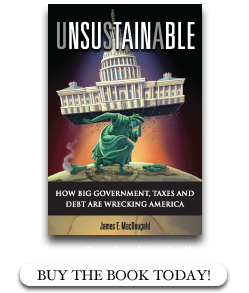
Unsustainable, Un-nerving and Un-American…a book review


America is under attack. But, I’m not speaking of the Islamists and other external forces who want to see an end to our western ways and capitalist system. We’re under attack from within and the means and methods of the war will surprise you…maybe even infuriate you.

Jim MacDougald has just written a terrific book for anyone who wants to fully comprehend the massive “bait and switch” the public sector has been pulling on the private sector over the past decade. While we (private sector employees and employers) worked harder and longer, paid more in taxes and saw our retirement savings funds whittled, the public sector employees (federal, state & municipal) saw increases in salaries, medical benefits, retirement program and pension plans. Is it any wonder that during the past decade the private sector lost three million jobs while the public sector increased its employees by two million? It all sounds lovely. The government created lots of steady jobs with outstanding benefits. What’s to complain about? Well, the complaint is that this massive shift of jobs from the private sector to the public sector is simply not sustainable. Aptly, the name of MacDougald’s immensely eye-opening book is, "Unsustainable."

In the book, the author provides massive detail, thanks to a team of researchers who has been collecting and analyzing this pay disparity data for a couple of years. I warn you, some of the public pay shenanigans, especially the “triple dipping” and “end of career spiking,” will get your blood pressure up. Whatever you do, don’t read this book after reviewing your latest retirement savings statements. At the crux of MacDougald’s thesis is simple mathematics. If the public sector keeps taking more from the taxpayers and small& medium businesses that make up the majority of our economy and uses it it pay itself total compensation (salary, pension, medical, vacation, etc.) at significantly higher rates than the private sector can afford, we will eventually crater our economy under the weight of an unsustainable economic system. The public sector doesn’t produce any revenues itself. It is reliant on the revenues derived from taxpayers and businesses. By adding more employees with greater pay, benefits and guaranteed pension plans, the public sector is adding unfunded liabilities to its future budgets. Because these liabilities are not required to be recorded as long-term debts on the Balance Sheets of our public entities, the massive obligations are hidden from us. Rather than tell us that a state’s budget is woefully inadequate because of the growing unfunded liabilities of out sized pension obligations, governors will trot out the school children and tell us that if we don’t pony up more taxes, then Johnny and Jennifer will suffer a lack of funding for adequate education. Journalists snap the pictures, capture the video and publish the sad stories and the extortion cycle works again.

MacDougald, who is the son of an Army Sergeant, created a highly successful business in the 80’s and 90’s, with thousands of employees. He doesn’t think he could replicate that success again in the present environment. He wrote this book because he felt compelled to share the information with as many people as possible in the hope of educating people and motivating them to take action. It’s the same reason he founded The Free Enterprise Nation, for which he serves as Chairman & CEO. www.thefreeenterprisenation.org

Read the book. See the facts about how government forces unionization. Learn how egregious the tactics are for making sure “civil servants” receive pension plans and lump sum payouts that you can’t get in the private sector. See how seniority trumps performance in our public education system. Arm yourself with the data so you and your family are not fooled again by the budget crisis extortion game. It’s a powerful, well-written book with lots of fresh data, but it is written in a very clear and non-technical manner. MacDougald is not an economist, (though he probably could be and his son is one) so the style and voice he employs is direct and easy to understand. It’s the author’s first book. I hope it’s not his last.

Wednesday, June 23, 2010

Debt, Valuations and the Death Spiral of Unsustainable Wage Growth in English Soccer


It is currently very fashionable for fans and media to question the sustainability of debt at certain high profile football (soccer) clubs in England. In fact, it is practically a sport unto itself at Manchester United, one of a handful of clubs owned by Americans. While it is always wise to use debt with an abundance of caution, the drama at ManU has frankly far exceeded the data. Personally, I think the hysteria is fueled as much about Yanks owning the English sport as it is about debt to equity ratios.

If one examines the situation at ManU purely from the perspective of the metrics and not as an impassioned fan or patriotic protector of the beautiful game, it is clear that the club is far from distressed. Since acquiring the club in 2005, the Glazers have grown the revenues, profits and valuation at an annual rate that outpaces the rate of interest on the debt. This acts to de-lever the club from a debt perspective. While the amount of debt is large (roughly $950 million), it is approximately half of the value of the club, which Forbes put at $1.83 billion earlier this year. The club has annual revenue of $460 million and profits of $150 million. A 33% profit margin is something every sports team owner would celebrate. This makes ManU the world’s most valuable and most profitable sports team. On top of those astonishing numbers, the team continues to win (three consecutive league titles) while making prudent, long-term decisions about its player development and wage bill. In our view, the Glazer management team has done an excellent job of growing the business and has proven it has the correct business model to manage its current debt levels. If you take a purely financial view, the fans of Manchester United should be quite happy about the current and future health of their club. And if the owners were English, they would be…at least for a while.

Now, let me tell you where there is real danger in English football. If you want to see where owners, boards and management are doing a poor job and jeopardizing the health of football clubs, look no further than the Coca-Cola Championship League. In the false belief that wage bill alone determines wins, too many clubs are spending their hard-earned money on players in an undisciplined manner. With pressure from fans and the desire to get a piece of the ever-growing media rights share from the EPL, clubs are spending beyond their means. If you examine the wage to revenue ratio of the last three seasons, you’ll see an alarming trend. The wage bill average has gone up as a percentage each year from 72% to 79% to 87%. Because media rights have far out-paced other revenue streams (attendance for example), there is an even stronger pull for Championship clubs to use debt to fund operations as a high risk gamble to buy their way into the EPL. The theory goes that once promotion to the EPL is gained, debts will be paid and all will be well. It’s a sucker’s bet. Deloitte’s Sports Business Group has issued a warning about the rising wage bills. We think it should not be ignored. If you study the past 15 years of English football, you’ll see that the path to insolvency is well worn. If you look at the NFL and the NBA today, you’ll see that the ability of management to control its single largest operational cost (wages/benefits), in the context of unprecedented economic weakness, is at the core of CBA negotiations and may jeopardize a 2011 season for both sports. http://www.forbes.com/business/sportsmoney/

So, what’s the point here? Our view is that English football clubs can actually gain from owners who are driven by the profit motive. The profit motive aligns shareholders, management and fans in regards to building a strong, healthy valuable organization. There are lots of opportunities today to find distressed football clubs at great values, but the key is management. The value of the clubs is in the ability of management to repair the broken balance sheets, improve the income statements, provide financial discipline and operate the organizations with a view towards long-term, sustainable success.

Sunday, February 21, 2010

Soccer, SEC Football and ESPN


Thanks mostly to ESPN, Soccer (Football in the rest of the world) may finally take its place as a “major” sport in the US.

I’ve never thought soccer was going to gain traction here in the states. After all, we have a truly unique sporting nation – three professional team sports (NFL, MLB, NBA) with the best players in the world and a collegiate system that not only feeds the pro leagues with annual talent but also generates tremendous fan interest. But the demise of Setanta in 2009 created the opportunity for ESPN to accelerate its move into the British market with EPL rights. With ESPN, the worldwide leader, putting a serious focus on soccer, expect the sport to slowly become a part of the US mainstream. No global sports media company has the resources, talent or culture of ESPN. No US media company has the global integration capabilities. However, even ESPN can’t just “manufacture” another major sport. Everyone has tried and failed over the past 30 years to put soccer on par with our other pro team sports.

There are two other factors that will help create the confluence necessary to catapult soccer to the mainstream in the US. The first factor is our shrinking world. We are more mobile, more communicative and more aware of other cultures today. Technology allows us to live, work and share… any thing with anyone at any time. The second factor is the game itself. I’m not talking about the beauty of the “on pitch” action mind you. I’ve never played the game and I’m not a serious fan. What I’m talking about is an unmatched intensity of affinity that football (soccer, I mean) fans possess. It is bigger than Red Sox Nation, Da Bears and LeBron’s Cavs. These fans are truly stakeholders – invested emotionally, mentally and fiscally to their team in a way that is hard to describe. I’ve witnessed it over the past three months first hand in my dealings with the Brits. The only example I can think of to compare the fan intensity of English Soccer is SEC Football. With SEC football fans, there are simply times when families, jobs and friendships take a back seat. I know that sounds strange, but spend a week in Alabama during the Auburn vs. Bama game and you’ll know what I mean. That’s the way it is for English Soccer fans. The results of their team’s match define, in large measure, their own individual worth – at least for a time. That sort of intense support transcends players, coaches and owners. The affinity is often passed from generation to generation – in some cases for a century and a half. The team brand is stronger than any individual. That’s the sort of brand loyalty that corporations yearn to possess. And that’s one of the reasons why soccer is going to make it in the US. ESPN knows that the US soccer market now includes fans of pro teams in England, Germany, Italy, France, South Africa, Mexico, Brazil and other countries where soccer is king, in addition to fans of the MLS and NCAA teams

The way soccer becomes mainstream here is going to be a little different than our other sports. It’s not our game. It’s the game of the world. Soccer will not become mainstream through the success of MLS – though I do think the league is starting to make significant progress with smart decisions to build soccer-specific stadia, embrace key immigration cities and showcase worldwide talent. Soccer will become mainstream through a combination of ESPN’s coverage of English Soccer (Saturday mornings in the US are now dedicated to the sport on the worldwide leader) and our American desire to eventually become the best at everything. It may take a very, very long time, but that’s where our nation will expect us to go… once we truly embrace the sport. We may never be the best in the world at soccer, but the thought of a global battle for supremacy in the sport means huge potential in the business of soccer – something ESPN will have had no small part in creating.

Saturday, December 26, 2009

Sports Programming, Content and Distribution


The marriage of NBC and Comcast feel right to me. ESPN has proven that owning sports content rights can be very profitable. Before ESPN, everyone thought sports programming was simply a nice lead-in to network programming or a compliment to news operations. ESPN proved that you can make money at sports and you don't need any other non-sports content to do that. Because markets are efficient, it was inevitable that someone would create a competitive programming and distribution business. Not that NBC-Comcast will be exactly like ESPN, but it will have the opportunity to do what ESPN does - be both global and local at the same time.

As mass markets divided into micro, niche and tribal markets over the last decade or so, ESPN was there to provide the very specific content to those consumers in search. While reaching these niche markets (billiards, bass fishing, NASCAR, high school sports, etc...), lately through multiple channels of distributions, ESPN was also able to pay the rights necessary to own the national/international content that drives large ratings and large revenues. This ability to customize programming to address hundreds of affinity groups while maintaining a national footprint for big events has made ESPN truly unique and powerful. It is good evidence of Al Ries's law of markets that tells us that over time, markets divide rather than converge.

The NBC-Comcast deal is good for consumers and for sports content providers. Robert Wussler, formerly head of CBS Sports and CBS Networks, used to tell me that nothing will ever be more important than the content. He told me, "be in the content business and you will always have programing partners." Neal Pilson, who followed Wussler at CBS Sports, commented recently that this was, "the biggest thing that has happened in my 40 years in broadcasting." With Comcast's regional sports networks and NBC's cable networks and national system, the new holdings company will have the flexibility to shift on demand to meet the customer demands of local and national audiences - creating the ability for marketers to target consumers efficiently in the process. This also very good news for the content providers. In order to continue to grow television revenues, leagues and content generators were all forced to consider the creation of their own networks. With two or three programmers possessing the wherewithal to pay those rights fees, that trend will likely slow or perhaps even end for now.

Sunday, September 20, 2009

Leadership, Restraint and Free Enterprise

On September 18th, Democratic Senator Evan Bayh showed great leadership. He wrote a superbly-timed and sobering Op-Ed piece in the Wall Street Journal. Though no one could argue with his wholly appropriate caution about increasing our discretionary spending while our national debt grows, I'm sure his article went over in Washington like a tax cut in Sacramento. Bayh's popularity among his fellow Democrats in Congress probably took a major hit. That's why he should be applauded by everyone else. What he wrote, in very Midwestern/fly-over language, was undeniable. "On our present course, we violate a fundamental part of our national character by taking from our children to satisfy our desires today," Bayh wrote. "Efficiency and frugality, common virtues in the private sector, must be incorporated into government, " he added.

This is what leaders do. Leaders go against popular sentiment and pressures to "go along to get along." Leaders speak up and take action when they know the present course is wrong. Leaders do what is right in the long-term - no matter how good it might feel to do what is popular in the short-term. Senator Bayh's leadership on this issue is well-earned. As Governor of Indiana, he cut spending, balanced the budget and didn't raise taxes. Perhaps his best paragraph in the article contained this, "we cannot indefinitely share with the less-fortunate resources we do not possess. Ultimately, a growing economy with increased revenues and a stable national balance sheet are the best guarantors of social progress."

What the senator was talking about is a concept that most of us understand - restraining the growth of the federal government. What many of us don't understand is the impact of all forms of government on the free enterprise system. More than 89,000 local, state and federal government entities dine at the table prepared by the private sector. Over the last couple of decades, their appetite has grown. In fact, it is accurate to say that our public sector guests are now quite bloated. They will have trouble pushing themselves away from the table. On September 22, the private sector is going to attempt to do something about this unsustainable predicament. Beginning on 9/22, the free enterprise sector (115 million employees and 5 million companies) attempts to put the government on a diet. Bon appetit.

Saturday, August 22, 2009

Convictions, Absolutes and Authenticity

It is easy for us to think and talk about what we oppose. Op-Ed pieces, talk shows and blogs are filled with what we dislike, find offensive or want changed. However, what we like, believe in and support tells the world a lot more about us than that which we oppose. To know a person is to know his/her convictions - the things that are absolute. An authentic person is one who knows in what he/she believes. Those beliefs define the core of a person. Those beliefs are the foundation of an authentic person. What are your convictions? What do you stand for? Do you know? Do you have a list? Here is my list of the 10 (ten) things I stand for. I recommend you give it a shot, too. What do you stand for?

I Stand For...

1) The Grace that comes, undeservedly, from God.
2) The Power of the individual.
3) The Love of family.
4) The Loyalty of a dog.
5) The Strength that comes from the wealth of a person's character.
6) The Beauty of untamed land.
7) The United States of America and its purpose in this world - Liberty for all.
8) Working hard, playing hard and giving the credit to those who've earned it.
9) Limited government.
10) Personal responsibility.

Tuesday, July 21, 2009

Brands, Characteristics and Relationships

I've tried to be a student of good brand management in my twenty years of marketing, positioning, selling and consulting. I try to read broadly on the subjects and stay in tune with the times and remain progressive in my thinking. Along the way, I've met some really smart, talented managers and most of them have been more than willing to share their best practices. Over these two decades, one voice has had the greatest influence on my thinking. No, it's not Al Ries, Jack Trout or Harry Beckwith - though they have been influential. His name is Chuck Jarvie. If you know much about P&G in the 60's and 70's or Dr. Pepper in the 80's, you know Chuck. Quite simply, he knows more about consumer marketing and brand management than anyone I've ever met and he has a gift for succinctly communicating the principles. With all of the excitement, confusion and hyperbole about Social Media Marketing today, I thought now would be a great time to review the basics as taught to me by Mr. Jarvie.

All brands have certain characteristics. No matter what the industry, these fundamentals do not vary. Only the tactics and culture vary. If your brand doesn't have all five, you might be offering "branded" products/services, but you don't command brand position. According to Chuck, here are the five essential characteristic of a brand:

1) A brand is easily identified and understood through its Unique Selling Proposition. Consumers know it and can easily and quickly summarize it.

2) A brand has true, measurable performance attributes. Consumers can tell you the actual benefits they derive from the brand.

3) A brand is price in-elastic. Its core customer is willing to pay a premium to obtain the benefits it offers.

4) A brand is long-standing and progressive. A brand is never a fad. It stays relevant to its customer through stability and is kept in tune with the times.

5) A brand maintains and ensures its value through a definite and sensitive consumer feedback system. This CFS anticipates shifts in consumer desires and satisfies needs in a proactive - not reactive - manner.

According to Chuck, most brand failures or products that fail to achieve brand status are a function of not having the consumer relationship right from the beginning. Or, in some cases, the brands that lose their status do so as a result of not maintaining and nurturing a "partnership" with their consumers. So, what is SMM if not a great new technology that allows us to communicate on a personal level with consumers - nurturing the "partnership" and deepening the consumer relationship with the brand? I'm not denying that the technology is new, exciting and powerful. I'm a big believer in SMM and actively engage in its use. However, the arrival of SMM does not change the fundamentals of marketing or communications. Brand management principles don't vary, they just adopt the technology that allows them to do a better job of staying in touch and progressive.

Tuesday, July 14, 2009

Global Warming, Good Intentions and the Perils of Bad Science

The administration and its promoters in Congress are now selling their latest spoon full of medicine that they promise is "good for us." Close your eyes, open wide and swallow hard. After all, who can argue with saving the planet for future generations? The cap and trade bill is the answer, or as our President referred to it, the "jobs bill." I don't know about you, but I love many parts of this planet and I very much want my grand kids to see and experience the spectacular beauty that is Earth. But I've read the scientific reports and summaries from across the globe and the numbers just do not match the rhetoric of global warming. In fact, the science that has been purported to support the postulate of man's "pollution" of Earth through the increased production of carbon dioxide is now being labeled as "junk" by an ever-growing community of international, credentialed, climate scientists. A list of sources for this data is under the "links" section of this blog. For a thorough (and thoroughly entertaining) review of this subject, read Green Hell by Steve Milloy.

So if the planet is not truly in peril from man's selfish need to drive V-8s down long stretches of highway instead of riding bikes to the densely new urban village/city, then why are we being asked to spend huge amounts of tax-payer monies to "discover, develop and market" green alternatives to reduce/slow global warming and thus save the planet? If the Zogby and Rasmussen polls tell us that a majority of Americans now believe Vice President Gore and his gang were zealously overstating the threat, why are we making huge financial commitments (our balance sheet doesn't look so good right now you know) and promises to the Europeans? My warm-hearted (but cold-headed) friends on the left will not like my answer. It is really quite simple. The broadly appealing ideas of doing good (government health care, government schools, government motors, government stimulus, government entitlements) are great covers to cleverly disguise the ultimate goal of every government...more government control and centralized authority. You can call it "cap and trade," but it's a tax on energy and it will affect everyone who buys gasoline, heating oil or electricity. We should not allow the laudable ideas and good intentions behind more government involvement to keep us from heeding the lessons of many past experiences with federal over-reaching. As George Will aptly put it in his column in today's Washington Post, "government is cumbersome, sluggish and inefficient." As examples, Will noted the US Postal Service lost $1.9 billion in Q2 and Amtrak has enjoyed 38 straight years without reporting a profit. Have you tried calling the IRS lately? Now, in the face of unemployment reaching double digits by year end, we are supposed to be in favor of more regulation, taxation and debt in the name of saving the planet?

Call me a publicly-educated, naive polluter, but I'm not buying what Washington is selling on this one. I'm all for developing alternatives to our dependence on foreign oil. I'm all for cleaner energy sources. I'm a conservationist. The idea of keeping America beautiful doesn't have to include creating new taxes and increasing burdens on private businesses. This is a time when we should be reducing the drag on private enterprise. This is a time when we should be supporting a robust free market battle for commercial solutions to these problems through capitalism. This is a time when the federal government should be tightening their budgets, reducing debts and improving the balance sheet...just like 95% of all businesses are doing all across this country.

Sunday, June 28, 2009

Legal Immigration, Assimilation & the American Dream

Since gaining our independence, America has been the world's host to dreamers all over the earth. For those who truly yearn for the opportunity to pursue a better life and possess the desire to work, sacrifice and learn; the United States of America has been the fertile soil in which foreign dreams bloom into prosperity. Our country is the globe's greatest example of a free, democratic, generous society largely because of immigrants from foreign soils. Though never losing their identity or cultural heritages from their own "Mother Lands," immigrants to the U.S. have always put their love of this "Land of Opportunity" first. They studied our history, embraced our laws and core beliefs and taught their children our language. In so doing, immigrants have contributed mightily to the richness and diversity of the American way...and to its uncommon success.

For the last decade or so, the traditions of legal immigration, and its underpinning laws, have been usurped. 75% of American citizens want illegal immigration controlled. We have a constitutional republic with specific codes to govern the legal immigration of those who want to become U.S. citizens. In North Carolina and in many other states, illegal immigration is overwhelming our budgets. We are putting huge strains on health care, public services, law enforcement, schools and other taxpayer-funded programs just when our economy is at its weakest in thirty years. It is not just our budgets that are suffering; illegal immigration is destroying our identity. The common threads that unite us all as Americans are being sheared by illegal immigrants who are unwilling to pursue the American Dream legally, unwilling to speak the American language and unwilling to contribute back to the economy from which they graft.

So what do we do? There are four things that must be done to reverse the unhealthy and unsustainable flow of illegal aliens:

1) We must secure our borders and hold perpetrators (and their countries of origin) accountable
2) We must crack down on intentional hiring of illegal aliens by employers
3) We must empower law enforcement to truly "enforce" established immigration law
4) We must eliminate all benefits (licenses, welfare, in-state tuition, etc...) for illegal aliens

This is not as difficult an issue as many in D.C. and Raleigh want us to believe. If 75% of us are for these measures, we should quell the endless debates and get on with the implementation. It's time for action. If your elected representatives don't have the guts, then support those that do. Our American Dream is too important to be held hostage by those to weak to defend it or too selfish to honor it. After all, it's not just our dream...it's the dream and the example to most freedom-loving people all over the world.

Friday, May 15, 2009

Tobacco, Liberty and Government Regulation

I'm not a smoker. I really don't care for the look, taste or smell of cigarettes. I know they cause serious health problems if used consistently over a long period of time. It's my decision not to smoke them. I do admit to occasionally enjoying a cigar on the golf course, however. In an act of full disclosure, I also must admit to being from a long line of tobacco farmers. The Pritchetts harvested tobacco in NC all the way back to before the Revolutionary War. I even spent two college summers working in a cigarette factory, along side of all the unionized laborers (that's for another article), learning why I needed to pursue education and business. My company's name is Tobacco Road Capitalists, which is both a nod to the agrarian and manufacturing heritage of the Old North State and a play on our national reputation for being the home to the best college basketball in the country. However, this article is not about tobacco, cigarettes, farming or manufacturing; it's about free markets, personal responsibility, minority rights and government regulation.

Twenty years after a California municipality passed a smoking ban, the politically correct/nanny state movement has made its way all the way to Tobacco Road. A bill is pending approval in Raleigh that would ban smoking in private establishments. That's correct - this is not a ban on smoking in public places or thoroughfares. This is a ban on smoking in private establishments. So much for the free market. To heck with the liberties of tax-paying citizens or of tax-paying, business owners. The government has deemed the risk to be so great to your health from second-degree smoke that it can't allow the market to decide. Apparently, the government believes you can't choose which restaurants/bars to frequent based on your personal views and they don't think proprietors would respond to the vote from the market as expressed by their pocketbooks and wallets? All of this in the name of keeping the public safe and reducing health care expenses? If the health concerns are so great, how about a ban on all sales of smoking products? That would truly be "putting your money where your mouth is." Call me a skeptic, but I really doubt the government's conviction on the health risk is great enough to forgo the tax revenues.

I believe this is simply another case of political pandering to a majority constituency at the expense of a minority group. It's a popular, politically correct piece of legislation. It's also more of a dangerous trend. The government is incrementally encroaching on our liberties. At the expense of sounding like a nutty, right-wing conspiracist, we do have to ask the question, "where does it end?" Are we to be trusted about the consumption of alcohol? Can we operate our vehicles safely? Should we really own guns? If second-hand smoke is dangerous, what about influenza and other illnesses that can be acutely transmitted in schools, Churches and grocery stores? I know I'm demonstrating absurdity with absurdity here - but you get the picture. The more power we give to bureaucrats in the name of protecting us from ourselves, the more personal liberties we cede. The more individual responsibilities we trade in for government guarantees, the greater the cost of government to "administer" the programs. Over the past 50 years, the growth of government spending has been dramatic - but only if you look at it over the long span. Government spending (federal, state and local) has grown, as a percentage of GDP, from about 20 percent to nearly 35 percent. It's like kudzu. You can't see it growing, but if you ignore it for a while and come back and look at it...you are amazed by how much it has spread and what is has taken over.

Thursday, April 30, 2009

NASCAR, Business Models and Growth


I have long admired many things about Nascar and the France Family that owns it. I think they are phenomenal at PR and very, very good at fan(customer) retention, among other things. Although starting very much through humble, boot strap efforts(like most successful businesses) 60 years ago, Nascar became quite sophisticated at linking drivers/corporate brands and fan affinity. With the help of strong television partners(ESPN really did the heavy lifting), great promotion-oriented business partners in the tracks(owned primarily by either SMI or the France Family through ISC) and a disciplined approach to honoring the traditional rules and spirit of William France, Sr; Nascar grew at a remarkable rate and became a legitimate, national sport. However, this editorial is not dedicated to "back-slapping" the guys and gals from Daytona. I'm here to share my thoughts on why Nascar is losing speed and how it can rev back up again. Though growing up in North Carolina, I'm not a true fan of the sport. I'm more of a "stick and ball" guy, but I've been to a few races and I know more than my fair share of passionate racing fans. What I know about the sport mostly comes from what I know about the business of sports after twenty years in the industry. In complete candor, I also must admit I did quite a bit of homework about eight years ago when the company I worked for was consulted to help an organization called TRAC(Team Racing Auto Circuit).

TRAC was one of the best sports business ideas I have seen, and trust me - I have seen a lot of them. I eventually became its COO for a period of time after helping the founders develop a strong business plan and secure capital. Don't just take my word for it, check with Carl Scheer, Robert Wussler, George Bodenheimer, Humpy Wheeler, Cale Yarborough, Ed Hinton, Joe Lecesse, Jay Klompmaker, Chuck Jarvie, Hank Jones, David Falk, Erik Spanberg, Bruton Smith, Charlie Bradshaw, Rick Flair, Bill Riley, etc... They were all there, in some form or fashion, when the start-up league was launched in 2001. For those of you who didn't here about it or don't remember it(probably most of you), here is the basic proposition: Combine the best attributes of traditional, full-fendered, oval track auto racing with the best practices and structure of major, professional sports leagues and you get the Team Racing Auto Circuit(TRAC). Unlike Nascar, the team owners were buying an equity stake in the league when they acquired their team. Unlike Nascar, the owners were business partners with the league and with the tracks, much like any NFL owner who manages and promotes his events but usually doesn't own his venue. Unlike Nascar, cost control for the owners was a major concern and creating a profitable, ever-increasing asset for the primary risk-taker was one of the league's major objectives. Unlike Nascar, which relies on individual driver affinity, TRAC tapped into the regional affinity of sports fans and racing fans by creating a local team, which consisted of three cars and three drivers and a point system that allowed there to be a team and individual champion for each race and the season. From an owner and corporate sponsor perspective, this was essential. As we have seen recently, drivers, owners and sponsors can quickly be put asunder and the fan equity remains with the driver. There is nothing wrong with that - the drivers operate in a free market system. They take huge risks and they should be rewarded commensurately. The problem is that the other interested business partners lose. Good businesses operate within the construct of multiple "win/win" alliances. When too many partners lose, the business can't survive. What happened to TRAC? Well, like many businesses, teams or families...failures are more often a product of internal forces than external ones.

So, why should anyone care about Nascar's business model? After all, aren't they virtually unopposed in the US motor sports industry with little competition and huge barriers to entry? The answer to the latter is, "yes." The answer to the former is simple. Over the past four years, Nascar television ratings have fallen 21%. Advertising expenditures on Nascar broadcasts were down 16% last year. Track attendance fell for the third straight year. Sponsorships of teams and the league are going away or cutting back significantly. Team owners are closing down shops, auctioning parts or looking for buyers at alarming rates. This is not a result of the weak economic conditions of today. This started many years ago. Because the business model is based on corporate sponsors footing the bill for operating costs, the biggest sponsors are aligning with the best drivers and the haves(big race teams) are clearly pulling way ahead of the have-nots. Owners don't have the proper diversity of revenue streams and the economic interests of the league and owners are not aligned. Owners need a share of the tickets and television. How does Nascar share revenue? The market needs to grow. It has stopped growing. It grew for a while in size. Through the opening of new tracks in new regions of the US, more people with similar demographic profiles came to the sport, but Nascar needs to grow in diversity. I'm talking about economic, educational, regional and ethnic diversity. To really grow, a business must make itself attractive to newer and wider audiences. Don't think of it as dividing the pie; think of it as making a bigger pie. Brian France is capable of doing this. I don't know him personally, but I'm told he is a very bright, forward-thinking executive. By chance, if you read this Brian, consider the Team-Racing concept. Tapping into regional fan loyalties, giving tracks more events, creating more compelling content for television partners and attracting well-capitalized, sports-owners will work. I'm not proposing that you scrap the current model and adopt 100% of TRAC's concept. That is not feasible or necessary. Nascar is still the best motor sports business. However, the time to make strategic moves is when you're on top. It's the difference between proactive and reactive. I do think adopting several of the concepts would be prudent. Perhaps you even consider creating a "developmental" league that lets you do some experimentation and refining? The tracks need the content. The owners need the upside. The sponsors need the ROI. Nascar needs to start growing again. You have plenty of smart people there in Nascar, but if you need a consultant...I'm open to discuss it.

Monday, April 20, 2009

Farmers, Entrepreneurs and the Lessons of a Dad

I'm a southerner. I grew up in North Carolina. My family roots go back to the mid-1700's and I am quite familiar(I know how to use a hoe, a maul and how to grind sausage) with the agrarian ways of my ancestors. In fact, from my father all the way back to Dr. John Pritchett (Planter, Chemist, Patriot), we Pritchetts have toiled in the soil. Though, I do it today in my own suburban yard as a form of cathartic relief from my business life. It's a small way to keep the link to the earth that I feel in my bones. Don't get me wrong, I never wanted to be a farmer. I did the math at an early age and decided I was going to do something else for a living. However, I will say that some of the most important lessons in my early life came at the side of my father as we worked the land. Trust me, farmers know a level of work ethic that is virtually unmatched by any businesses I have ever seen. Farming, before government subsidies, was the essence of being an entrepreneur. Here is why.

Farmers have to get up early and take advantage of the daylight. As most farmers know, "burning daylight" is a sin. The same is true for entrepreneurs. A "first mover" position is critical to most successful business ventures.

Farmers have to adapt to the changing weather. No matter how much we might try (even with help from the Farmer's Almanac), we just can't predict the weather. The same is true for entrepreneurs. No matter how solid the business plan, market conditions change and businesses need to be nimble and adaptive.

Farmers treat their neighbors, suppliers and "hands" well. You never know when you might need to borrow a tractor, a ton of fertilizer or a bushel of beans. The same is true for entrepreneurs. Treating suppliers, community cohorts and employees well will build up a reservoir of good will that you may need to tap one day.

So, using a little "plain speaking" here, the message is simple. Get in early; Be prepared for anything; Treat people with respect. May your corn be sweet and your profits even sweeter!

Tuesday, April 14, 2009

Taxes, Self-Reliance and Conservatism

Tax Day is here. If you did it right, you don' t owe the government anything. Regardless of your payment on the 15th, we're all paying more than our share. In fact, Americans are paying more than ever. Cost of Government Day (COGD) is the date of the calendar year on which the average American worker has earned enough gross income to pay off his or her share of spending and regulatory burdens imposed by government on the federal, state and local levels. Cost of Government Day for 2008 was July 16. Working people had to toil on average 197 days out of the year just to meet all costs imposed by government. In other words, the cost of government consumed 53.9 percent of national income. Wait, it gets worse. The 2008 tax code was part of the "lower taxes" administration. You don't think the present administration is going to reduce the cost of government do you? Steve Forbes - where are you when we need you?

Friedrich Hayek's economic ideas - belief in smaller government, lower taxes and free markets - are the roots from which fiscal conservatives bloom. The concept is so remarkably simple. Reduce the tax burden on producers and watch how revenues to governments grow. It is not a mathematical theory or postulate. It is something for which the "null hypothesis" has been eliminated(researchers rejoice). I met with an executive of the NC Chamber of Commerce today and was disappointed, but not surprised, by the rapidly increasing cost of doing business in The Old North State. We are making ourselves less attractive to private businesses every time we allow the trial lawyers and unions to drive up the costs of doing business here. As the CEO of a private company that filed tax returns in over 40 states today, I can tell you it doesn't take long to tell which states are business-friendly and which states are taking the short-term approach to increasing revenues. In the Tarheel State, we need get back to our conservative roots - work, family, self-reliance, enterprise, personal responsibility...and a welcoming spirit - driven by a lower cost of living and a pro-business environment. If we don't reverse this course soon, we'll be known as the Garden State South...and not just because of all the NJ students at Duke!

We need to be diligent about not getting lulled into thinking that all of these fees and taxes (federal, state and local) are necessary to improve our lives or the lives of lower-income people. We have enough data over 235 years to know that more money does not correlate to better results when the bureaucracy of government collects and redistributes. I am a conservative because I reject that concept. I choose to take an optimistic view that all of us, given the opportunity, can build our own wealth by actively participating in capitalism. I reject the "one-size-fits-all" model of government and place my trust in each individual to make decisions about the services they receive. Citizens need the freedom to self-govern. The opposite of self-governance is dependence. Dependence is the absence of freedom. Freedom is what beats in the heart of every human.

Friday, April 10, 2009

Golf, The Masters and Capitalism


Watching "The Masters" over the last couple of days got me thinking about azaleas, capitalism and gentlemen. Professional golfers are my favorite pro athletes by far. Why is that? Because they compete in one of the only major sports that doesn't use a socialistic design to ensure outcomes for athletes. Pro golfers don't get salaries and the PGA doesn't constantly tinker to achieve "parity." You can't guarantee outcomes - only opportunities. The pay in pro golf is in direct proportion to a player's willingness to practice, train (body and mind), prepare and compete. Win or make cuts and you earn; miss cuts and you find a new profession or become a teaching pro. Every week, their score determines their pay. They can decide not to play in a particular tournament or to play in every one, but the decision and consequence is theirs. No team plane takes them to a tournament; no hotel rooms and meals are arranged and paid for them; no trainer wakes them up and tells them where to be and at what time; it is the ultimate in personal responsibility.

Many people believe pro golfers were born with a silver spoon and therefore haven't really "worked" to earn their economic status. Kind of the way many liberals believe high-earners and achievers somehow found their success on the backs of others rather than through schooling, dedication, sacrifice, discipline, talent and time. Let me suggest two names... Arnie and Tiger. Arguably, two of the best players in the history of the game and two of the biggest earners, too. Both of them were raised in working class families, not in posh neighborhoods with annual European vacations. They took advantage of their opportunity. They proved that in this country you have the opportunity to do and be just about anything...if you are willing to put in the work and take the risk. You know what else? Pro golfers and the PGA and other professional golfing organizations are the biggest contributors to charity in all of professional sports. It isn't even close. More proof that private enterprise and private citizens do wonderfully important things without government assistance.

Finally, I like pro golfers because they understand the sport is essentially based on rules and they depend on each other's personal character and devotion to honor the game. The sport doesn't need referees. Players call penalties on themselves. It is a beautiful example of an efficient, free, market system. The players respect the game, they respect the men who came before them and they respect the amateurs and fans who keep the sport healthy. They wear their shirts tucked in, their hats on straight and they shake hands with their competitors at the conclusion of the match. America's children could learn a lot from that. As for the azaleas, I planted seven new ones in my backyard this morning.